09 January, 2008

Whoa....

Can I get an "amen"? Check and balance! Check it:

House Launches FCC Investigation; Warns Against Destroying Documents
House Energy & Commerce Committee Looking Into Federal Communications Commission's ‘Regulatory Procedures and Practices’

By John Eggerton -- Broadcasting & Cable, 1/8/2008 4:38:00 PM

As promised, the House Energy & Commerce Committee launched a formal investigation into the Federal Communications Commission's "regulatory procedures and practices."

The committee was following up on a Dec. 3 letter asking the chairman about procedural criticisms.

Committee leaders advised Martin Tuesday that they expect FCC staffers to cooperate and ordered the agency to start preserving all documents and e-mails, adding for emphasis that no historical records "shall be destroyed, modified, altered, deleted, removed, relocated, or otherwise negligently or intentionally handled so as to make them inaccessible to the committee."

The investigation followed complaints externally and internally about how items were brought to a vote, information that was leaking to some lobbyists and not to others and complaints about Martin's resolve to vote on modifying the ban on newspaper-broadcast cross-ownership -- which passed Dec. 18 -- despite attempts to stop or delay the vote by members of FCC oversight committees in both Houses.


Look, read the entire article here.


It’s Not the Same Game

Terry Heaton posts a new blog entry entitled "Local Media in a Postmodern World" that's worth a mention.

Reposted below with permission as indicated in Creative Commons license 2.5:

Local Media in a Postmodern World
It’s Not the Same Game

by Terry Heaton


This piece examines changing fundamentals of media in the new world, primarily how mass marketing is increasing problematic when access to the mass is what’s restricted. We’ve all grown up in an industry where value was created by restricting access to content, so what we’re dealing with today is, in many ways, the opposite of what we know.

One important factor to consider when reading my essays is that I don’t approach this stuff as a zero-sum game. New media won’t “replace” the old — at least not for a very long time. Mass marketing will continue, but it would be foolish to assume that it alone — or any variation thereof — can rescue the sagging revenues of local media companies. This is why we must follow a dual path approach, which is the foundational strategic principle of AR&D’s Media 2.0 unit.

------

During the Vietnam War, I was stationed at a long-range navigation base in the Philippines with 15 other guys. Our beacon was used by the B-52s to guide them as they bombed North Vietnam. It was considered "isolated duty," and we had a lot of free time on our hands, especially during the rainy season. We played poker and a wonderful game called Euchre, a trump game where the jack of trumps is the highest-ranked card and the jack of the other same colored suit is the second highest.

Euchre is only popular in pockets around the states, so we had to teach it to newcomers who joined us on the base. One guy, a fellow from New Jersey named McDowell, said, "Oh, this is like Hi, Lo, Jack and Game." Actually, the games had little in common except the use of trump, so we set him straight.

"No, there may be similarities, but that's a different game. This is Euchre."

A few years ago, I was delivering my new media message to a group of media executives led by a man with great vision and skill. His history and thinking, however, was all based in the Media 1.0, mass marketing paradigm, so his disconnect with the Media 2.0 concept was along these lines:

"No matter how you slice it, Terry, it's still the same game."

He was referring to the assembling of audience, whether en masse or by grouping fragments. This has long been the central framework for advertising, and it is in this area that media companies have considerable expertise. But is it true? Is the revenue challenge for media companies today one of understanding new rules for the same game, or is it a new game altogether?

As we said to the newcomers back in the Philippines, "There may be similarities, but it's not the same game."

Jeremy AllaireLate last year, Jeremy Allaire, founder/CEO of Brightcove and one of the brightest minds in technology, wrote in his predictions for 2008 that nothing about the Internet changes the fundamentals of media, adding that "value is created by controlling the content or controlling access to the audience."

"Media companies with established brands and new start-ups," he continued, "will continue to build successful branded destinations so they can control the access to audiences."

This is quite a statement, and one that bears close examination in light of disruptions to mass media, disintermediation, unbundling and the escalating fragmentation of all forms of media. The key fundamental that has shifted is that the pyramid is upside-down. The people formerly known as the audience are now in charge. Access to the audience, therefore, is what's restricted today, not access to the content.


It's the opposite of mass marketing. Consider the soapbox image of a guy above a crowd pitching his message, the preacher at the pulpit, the anchor at the news desk, or the full page ad in the paper. These are all one-way messages from the source to the crowd. The Web, however, makes the opposite possible. The consumer is on the soapbox facing a sea of messages. The mission now is to make those available in an easy-to-access form.

We're in an "unmarketing" era now, one wherein attraction is the key to value creation, not promotion. The days of the captive audience are gone forever, and how do you "control access to content," when your content is either being commodified or replaced by that which isn't controlled? In an era of attraction as the key to growth, more attention — and resources — must be given to product creation, not marketing. What we say about what we create was important in a top-down paradigm, but it's mostly meaningless in a world where users are in charge.

So the assumption that controlling access to content is still a valid business model in today's disruptive environment is problematic, at best, and more likely, dead in the water altogether. There are three issues to consider:

First of all, the "branded destinations" spoken of aren't unique in the architecture of the Web, and this is a problem. It doesn't matter how many people "visit," how long they stay, or what’s available through any particular URL, the Web considers them all the same, what I call pixels on a page. Therefore, any system of control is fragmented to the nth degree. Cable changed the value proposition of broadcasting, and the Web does the same to cable. We can spin things with HDTV and other things like specialized content, etc., but the dynamic is the same as what drug companies encounter when patents expire on their products. "Time-released" becomes the selling point, not the product itself. But people — who are driven by price — go for the new generic. Same with content creators. No matter how we spin it, it’s just another pixel on the page in the architecture of the Web.

So from a structural perspective, the media value proposition is lessened, because the eyeballs necessary to earn from that "value" have thousands, if not millions, of other choices. Moreover, as content becomes more and more commodified, it gets harder to identify any of it as "special."

Secondly, the assumption requires a belief that this "content" has sufficient qualities to compel the eyeballs in the first place. This, too, is a problem, because the creators of professional content have known — even before people starting unbundling things for themselves — that it was getting harder and harder to produce profitable demand. There were many factors at play here, but the one that the creators least wish to discuss is that content built on previous success — that is to say content based on research and history — does not necessarily lead to audience growth. And without growth, the fundamentals are meaningless. Hollywood, the record companies and the rest of the copyright industry are largely victims of the crap they've been producing for years. But crap is easy — and it can be profitable.

It is into this paradigm that J. D. Lascia's "personal media revolution" has blossomed, people educating and entertaining themselves with technology’s help. Nokia is predicting that in just five years, this type of "media" will account for one-fourth of all entertainment in the U.S.

The value of YouTube has never been in the distributing of the kinds of content described in media accounts of alleged pirating; it has always been about growing communities who are entertaining themselves. Professional video creators can scoff at and discount this all they wish, but eyeballs viewing this type of content are eyeballs that once needed the restraints of those creating value through restricted access.

Thirdly, and perhaps most importantly, this assumption dismisses the contemporary reality that advertisers — the people who funded the assumption in its earlier times — don't need the content anymore in order to do business. Advertising IS content in Media 2.0, and where money is spent by advertisers in creating their own content, it is not being spent on supporting the content of Jeremy’s "branded destinations." Some advertisers are actually becoming their own media companies, and this challenges the assumptions of traditional media.

The problem may not be that the value proposition of media is changing as much as the definition of media itself, which is why companies must proceed down simultaneous strategic paths — monetizing their "content" as best they can but also moving to become portfolio companies by innovating in the worlds of advertising and Media 2.0.

So "media" is not the same game as it was in the old world, and the most dangerous move any media company can make today is to operate as though it's simply a matter of rules changes. It's not. It's a new game, and the rules aren't so much about gathering audience (en masse or fragmented) as they are about two significant value creation opportunities:

  1. 1. Helping the people formerly known as the audience do their own thing. The rise of personal media is a significant opportunity for local media companies, because in producing their own forms of media, people are demonstrating a desire to do what we do and know what we know. If nothing else, we can teach them, but by enabling this — actually helping the process — we are in a better position to organize and aggregate its output in a variety of new businesses.

    At a conference of leading edge technical types — pioneers, if you will, of personal media — I asked 500 people if anyone would be interested in a subscription service of raw video that they could use as they wished. Every hand in the place shot up.

    There is a market for people creating their own newscasts or creating videos from archival material that's currently just sitting in vaults across the country. This is money waiting to be made.

  2. 2. Helping the people formerly known as advertisers do business. The aggregator of the messages is the opportunity here. I wrote about this three years ago in "The Economy of Unbundled Advertising," and it's still a valid business proposition for local media.

    Letting people search for the messages they want is clearly one of the paths before us, and it will spawn a whole new form of attraction-based advertising, which will enable commerce in our communities and return local media to a key role therein.


There are business and governmental issues in a world where the "top" is occupied by everyday people. How does one grow a business, for example, when access to the mass is restricted? We'll figure that out. The real meaning of branding will be the foundation of new approaches, for the need to stand out in a crowd of other messages is the real challenge. We're already developing primitive solutions through, for example, search engine optimization.

What about civil defense? How will we get the word out to people in times of emergencies? We'll figure that out, too. Just as we do now, messages of local, regional, national or global concern could be assigned a priority.

And the warning for media companies is serious. We can either participate in the new game, or we will have to deal with increasing irrelevance, because somebody else — most likely the internet pureplay companies — will do it instead.

WSC Show #60 - Reinterview with Bill Froehlich


powered by ODEO

In today’s episode I head out to the picket line at CBS Radford Studios to revisit with strike captain Bill Froehlich. Here, he shares how he’s keeping his creative edge as the strike enters its ninth week. He also tells us his experiences with his mentor: the legendary Rod Serling. Recorded Tuesday, 8 January 2008.

Credits
Producer/Host: Tanja Barnes
Music: "Ay Mambo" by Falik
available on
Magnatune.com


08 January, 2008

United Hollywood's 1st Annual Short Film Contest


A few weeks ago, Jeffrey Berman from United Hollywood gave me the scoop on the FairDeal4Writers video contest. They're looking for videos on how to get the Moguls to make a fair deal, but they've also recently expanded the scope of the contest. You can now choose to make a film on any WGA contract issues that inspires you.

Get the contest rules here.

Jeffrey is probably one of the hardest working guys around. I've seen him practically every time I go to the lines. He diligently goes about collecting the autographs for the big prize: an authentic WGA strike poster with over 150 signatures, autographed by writers, actors, actresses and directors who signed it while on the picket line. I've seen it and I have to say: it's super cool! Nice job, Jeffrey!

For more information about United Hollywood's 1st Annual Short Film contest, log on to FairDeal4Writers.com.


Welcome to the Human Network


I tagged this in my del.ici.ous, but it's worth a separate blog post. In addition to announcing the Entertainment Operating System (EOS) at CES this week, Cisco goes all out with the "Human Network."
You can drag and drop people wherever they want to go!

(OK, who wrote that?)

Drag me baby! I love it when you drop me like that!

Is it the MyFace killer? Pro'ly not. It will most likely represent to social networking what the NY Times is to journalism. Perhaps, it'll give Current TV a run for the money.

I think the thing that disturbs me about this so-called human network ad is how young everybody is. I mean, the preponderance of millenials as opposed to boomers and even gen x'rs speaks volumes to me. Teenage wasteland, indeed.

I don't get it. Right now, the site seems to be just a random collection of blogs and websites that use Cisco products. Social networks are not about products, they're about people and the community those people create.

My two cents. YMMV.


--

UPDATE - 01/09/08 12:04 a.m. - I cross-posted this to my personal blog and got this comment from a friend: "Welcome to the digital divide, the new caste system, welcome to the ever widening chasm between wealth and poverty, welcome to the new world order… Welcome to globalization, powered by CISCO." Yeah. What he said.

UPDATE - 01/09/08 12:17 a.m. - This was posted on my personal blog. I *heart* this! Now we're talking!


MediaBytes 01.08.2008


Shelly Palmer continues expanded coverage of Media Bytes at CES. I love the way he cuts it right down into a byte sized snack.

Larry Lessig at TED – March 2007


How creativity is being strangled by the law: Larry Lessig at TED, March 2007.


In light of Sony BMG's announcement to drop DRM (and the subsequent announcement that Napster is going back to mp3s), I thought a little celebration is in order. Here is lawyer, Stanford law professor, and founder and CEO of Creative Commons: Larry Lessig at TED this past spring.

Also, a great debate between Lessig and Jack Valenti:


powered by ODEO


WSC Show #59 - Fair vs. Equitable with Aaron Solomon and Richard Buckley, Jr.


In today’s episode I go to the strike line at NBC studios where I meet up with writer Aaron Solomon and actor Crown Prince Richard Buckley (son of Lord Buckley!) to record what is probably my shortest podcast to date. Recorded Thursday, 3 January 2008.

Anybody want to help me code an XML feed? Hit me!
Credits
Producer/Host: Tanja Barnes
Music: "Ay Mambo" by Falik
available on
Magnatune.com


07 January, 2008

MediaBytes 01.07.2008


CES: Toshiba's response to Warner ditching HD-DVD


From ShinyMedia


We now resume our regularly scheduled podcast (?)

It looks like Odeo fixed their equipment problems and my little mp3 player is available for y'all to grab the podcasts I loaded this weekend. I have a new one I was meaning to load when their server failed, and I'm kinda nervous to post it now until I'm sure they got all the bugs worked out. New podcast tomorrow, if all goes well.

Stay tuned!


CES: Bill Gates' Keynote "Next Digital Decade"


Bill Gates says he's calling it quits at CES this year, but not without some jabs at Steve Jobs and of course, some announcements.

Up and coming for Microsoft:
- deals to offer the entire MGM movie library and Disney/ABC television for download via the Xbox 360;

- specifcially 500 hours of programming in both standard and HD including such shows Desperate Housewives, Lost, Grey's Anatomy;

- renewed partnership with NBC to bring the 2008 Beijing summer Olympics on-line both in live broadcast and on-demand video. You may recall, they did this in winter games 2002 for the Salt Lake City.

Details Fox Business News (fair and balanced!).


Distributing progressive voices on Internet TV

A recent blog posting from Shai Sachs about Internet TV as tool for progressive media:
The key to building a mature Internet television industry friendly to the progressive movement is an open, fast, cheap, and user-friendly pipe that goes directly from content producers to content consumers (and possibly in the reverse direction as well.) In particular, that means building (or latching on to) a cheap set-top box that attaches easily to a living room TV, and works with a reasonably easy-to-use remote control. It also means a set-top box that offers programming from an open network, and doesn't lock viewers into a closed network.
The one thing I'll dispute him on is this: "If Internet TV ever gains enough market penetration to rival cable TV, we will still need to work on offering attractive, compelling content, and properly distributing that content."

Dude. Strike that "If" to "When". It's only a matter of time.

As referenced in his post, I loves me my Miro player.


06 January, 2008

Technical Difficulties


Today's episode of the Writers' Strike Chronicles podcast is delayed until further notice. Odeo, the website from which I upload the feed, is down and I am unable to connect at all. This also temporarily disables the use of the embedded mp3 players used in this blog.

Until then, why don't you tell your own story?


Make a film. Get involved.

What TED said. Word.


CES: JVC's LCD HDTV


Now this is kewl! JVC announces a line of LCD TV sets with integrated iPod dock at the CES 2008.

Read more in Yahoo news here.


CES: iLuv i255 desktop iPOD/DVD Player


Oh, it's another shiney black box! iLuv brings the iLuv i1255 at CES. It's luv-erly!

Features:
- Plays music from audio CDs, MP3 CDs and docked iPods
- Remote
- Dock adapters for a variety of iPod models
- Video out lets you view iPod video on-screen
- On-screen navigation
- DVD player supports DVD, VCD, MP3 CD, Audio CD, JPEG CD, and Kodak Picture CD

The iLuv i1255 is expected to ship in March and can be yours for $130.00. More here.


05 January, 2008

CES: Is Archos TV the black box of the future?

Archos TV is introducing a new set-top box at CES next week.

Engadget had a review of the product way back last summer.

The question (at least in my mind) remains: will it be a competitor for Apple TV?


FWIW, though I'm a Mac fanatic, I'm unconvinced Apple TV is the end all and be all in this race to bring the ultimate black box to market.


Leno and Kimmel To Guest On Each Other's Show

NY Times is reporting:
"In an unusual act of solidarity emerging from the screenwriters’ strike, two of television’s late-night hosts, Jay Leno of NBC and Jimmy Kimmel of ABC, will appear on each other’s shows on Thursday. The appearances were confirmed by two representatives associated with several of television’s late-night shows. The two hosts and their networks will announce the arrangement on Monday, said the representatives, both of whom asked not to be identified because they were not authorized to speak for the hosts."
Read all about it here.


Cross-posted from my del.ici.ous bookmarks

Seems like one of the conglomerates, of which the writers' are striking against, is dabbling in politics. At least that's what Dennis Kucinich is alleging.

This just in from the AP:
ABC Cuts 3 From Presidential Debate
By David Bauder


NEW YORK (AP) — Democratic presidential candidate Dennis Kucinich filed a complaint with the FCC on Friday after ABC News excluded him, fellow Democrat Mike Gravel and Republican Duncan Hunter from its prime-time debates on Saturday.

Kucinich argued that ABC is violating equal-time provisions by keeping him out of the debate and noted that ABC's parent Walt Disney Co. had contributed to campaigns involving the four Democrats who were invited.

"ABC should not be the first primary," the Ohio congressman said in papers filed at the Federal Communications Commission.

How do you spell monopoly?

Read the entire article here.


A David Lynch iPhone Commercial...NOT!


Somebody took footage from David Lynch's Inland Empire limited edition DVD and had some fun with it.

Ask A Ninja's
Kent Nichols thinks David Lynch is a tool. Here's an excerpt from the rant he blogged, but it's worth reading the entire post:
If someone wants to pay you to watch your weird little films on a cell phone or a DVD or a flipbook, just smile and take the money. Short of inviting every potential viewer to sit and watch it in your personal viewing chamber, there is no “ideal” viewing experience. There’s just content and people. People want the content, we give it to them.

WSC Show #58 - Interview with Kevin Droney


Featured today is strike captain Kevin Droney at the picket lines at NBC Studios. In this recording, Kevin and I actually walked the lines so it’s possible and probable that the sound quality is a bit uneven. Recorded Thursday, 3 January 2008.

Credits
Producer/Host: Tanja Barnes
Music: "Ay Mambo" by Falik
available on
Magnatune.com

04 January, 2008

NBC to Host Its First Digital Out-of-Home Upfront

I posted this in my del.ici.ous bookmarks, but thought it was worth a cross-post here.

Advertising Age is reporting that:
"In a sign of the emerging power of TV outside the home, NBC Universal will hold what media buyers are likening to an "upfront" presentation for its digital out-of-home assets Jan. 16. The media company is hoping to get more advertisers to consider NBC for placing ads on TV screens in supermarkets, near gas-station pumps, in taxi cabs and arenas, among other places. Set to be held in Studio 8H, the NBC presentation will address approximately 200 advertisers and media buyers."
Entire article here.

On a side note, I've been invited to contribute some of my del.ici.ous bookmarks with United Hollywood's. What an honor! UH steps up to crowdsourcing!

Look for my participation in bookmarks that will be tagged "uhlinks" on my tag roll and tag cloud.

My posting guidelines as suggested by John Aboud of UH, are as follows:
1.) something not from one of the major sites we all get news from (Variety, Nikki Finke, Defamer, LA Times. United Hollywood will have a separate page for them);
2.) can be either about the strike directly or about the future of content online (ah, my favorite topic!);
3.) not "breaking news" but interesting background or analysis.


MediaBytes 01.04.2008


The Future of Social Media Web Sites


Mikhail Tuknov offers up his five year prediction of social media websites. In his estimation, the massive social experiment of Web 2.0 is not the mullet of the millenium. Here's a quote:
While there is no doubt that social media sites are a genuinely groundbreaking innovation that is changing the way we communicate in many significant ways, past experience with similar Internet phenomena shows that the hyper charged atmosphere of excitement cannot last indefinitely. The industry is currently characterized by easy capital, plenty of media attention and widespread user curiosity-all of which directly boosts creativity-but all that will come to an end eventually.

This does not mean that there is no future for social media sites. On the contrary, the future is just as bright as ever and at this relatively early stage of the game, it is hard to predict just how huge the whole industry can get. What companies and investors should do however is to adapt their approach to be prepared for the changes that will inevitably come in the future.
What I find most interesting is this snippet regarding the long tail of Facebook:
The founder and chief executive of Facebook, Mark Zuckerberg, has officially stated that his despite his company’s spectacular growth, Facebook is still many years away from flotation.
OK, so math is not my forte, as evidenced in some mistakes I've made in reporting figures and numbers in my podcast. But...this past fall, Microsoft purchased a 1.6% share of the company for $240 million. So like, I just don't get what he means by that.

Read the entire article here.


WSC Show #57 - Social Networking with Penelope Q.


Today’s episode features one of the newest members of the Writers’ Guild of America: 22 year-old Penelope Q. Recorded Thursday, 3 January 2008.


Clip from Art Film Talk #23 Marshall Herskovitz, Quarterlife used with permission by David Tamés.

As mentioned in this episode: "Viewing American class divisions through Facebook and MySpace" by Danah Boyd


Credits
Producer/Host: Tanja Barnes
Music: "Ay Mambo" by Falik
available on
Magnatune.com


03 January, 2008

An Open Letter To The A.M.P.T.P.


Click on image to embiggen.


This message, sent special delivery, is brought to you by the Bureau of Communication. Send yours today!


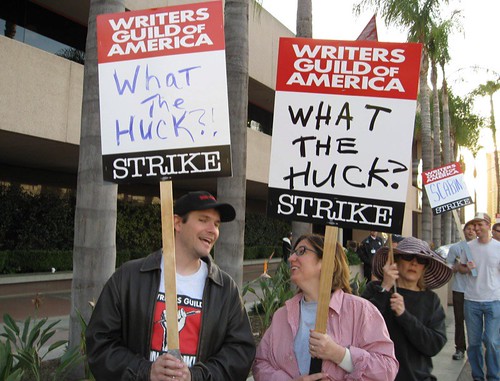
"What The Huck?" picket signs (January 2, 2008)

More photos from yesterday, courtesy of BeastandBean.

Photos From Late Night Picketing @ NBC


DSC_4071, originally uploaded by NoHoDamon.

Great set of photos from Damon, who jokingly referred himself as the WSC staff photographer.

Who won late night?

Since my blog and podcast are not breaking news, I'll leave it to some Live Bloggers to report on the this evening's historic late night programming:


There's also the Google news feed as well. And, of course, your Nikki Finke's, United Hollywood's, Defamers, et.al. While y'all are watchin' late night, I was mixing today's podcast. And lovin' it, too.

UPDATE: 2:52 A.M. Well, well, well. Looks like Variety is live blogging, too. You know where to go to find their take. Cheerio!


WSC Show #56 - Late Night Television Returns: David Titcher, Diane Saltzberg, Gregory Storm and Linda Vorhees


This episode is a continuation of late night television picketing event held at NBC Studios, home of The Tonight Show with Jay Leno. Featured today are writers Diane Saltzberg and David Titcher, two guests I’ve had on the show in the early days of the strike. Then, we’ll hear from writers Gregory Storm and Linda Vorhees. Recorded Wednesday, 2 January 2008.

Credits
Producer/Host: Tanja Barnes
Music: "Ay Mambo" by Falik
available on Magnatune.com


Related Posts Plugin for WordPress, Blogger...
 

Back to TOP

Glamour Bomb Templates